
The Johari Window
We all walk around with a clear picture of who we want to be. The strategic thinker. The reliable event manager. The empathetic leader. But here is the uncomfortable truth: that isn’t always how the world sees us.
I first encountered the Johari Window through my tutors, Ali and Barbara, at the Inter Psyche Training Institute. As a naturally confident, vocal woman, my window was always wide open. But I soon realised that effective communication isn’t just about being an open book; it’s about the art of tailoring your openness to the person standing in front of you.
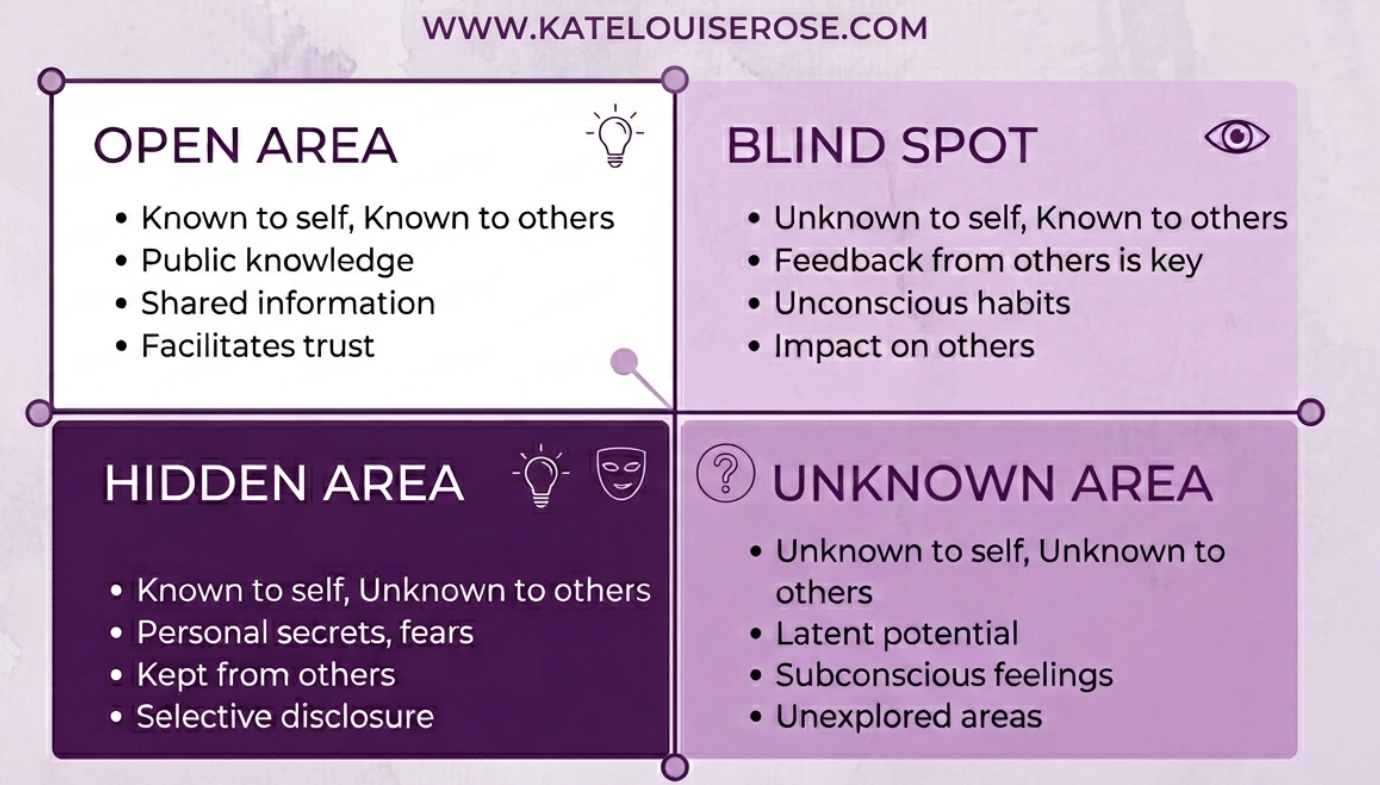
What is the Johari Window?
The Johari Window was developed by psychologists Joseph Luft and Harrington Ingham in 1955. It's a simple yet effective tool for understanding and improving self-awareness and interpersonal relationships.
Underlying the model are two factors: what others know about us, and what we know about ourselves. The overlap consists of shared knowledge, while outside of either lies the truly unknown.
The model consists of four areas that represent different aspects of the self:
The Open Area: In the overlap, we find the common knowledge that both you and others know. At first, this area might be mostly populated by superficially obvious things.
The Blind Spot: Here lie the things others know about you, that you don’t yet know about. Nerve-wracking, isn’t it? They might have spotted a behaviour pattern that you’ve overlooked, interpret your actions in a different way than you intended, or (here’s hoping) secretly find you to be utterly amazing and wonderful, all of the time.
The Hidden Area: Facts and perspectives that are known to you, but not to others. The hidden area of the Johari window might include…
your internal perspectives, opinions and motivators that aren’t visible to external parties
your intentions, rather than your actions
things about yourself you’ve simply never thought to mention
things you assume other people must already know, but they actually don’t
and of course, things you keep intentionally private!
The Unknown Area: What is unknown to both you and others. The true unknown. These are the things that nobody has worked out yet, not even you.
Our habits change depending on our environment. In unfamiliar settings, we keep our windows small. In safe, trusting spaces with like-minded people, we throw them wide open. Interestingly, different professions often attract specific styles. While an Engineer might only open up around their peers, an Event Manager usually keeps their window open regardless of the setting as our roles practically demand it. By understanding these areas, you can set to work on expanding your open area, reducing your blind spots, and selectively sharing from your hidden area to build trust and rapport with colleagues.
Research suggests that individuals with higher self-awareness tend to have better psychological wellbeing, more satisfying relationships, and improved job performance (Sutton et al., 2015). Self-awareness allows us to manage our emotions, align our behaviour with our values, and communicate more effectively.
Similarly, appropriate self-disclosure builds trust, intimacy, and rapport in relationships (Collins & Miller, 1994). In the workplace, it can lead to better teamwork, increased job satisfaction, and more effective leadership (Jourard, 1971)
I run a little experiment. Since I use Gemini as part of my business workspace, I gave it a specific prompt to see what an AI sees when it looks at my digital footprint.
A quick word of warning: this is a fun exercise, and we should bear in mind that AI can big you up with ego boosts that aren't always 100% accurate! But even so, the reflection is fascinating.
The Prompt:“Run a Johari Window on what you know about me.”
Here’s a snapshot of what Gemini reflected back to me:
Open Area: It recognised my 25 years in high-end hospitality and my work as a Wellbeing Event Consultant and Yoga Teacher. It picked up on my mission to help people find their feet again and my direct, no-preamble communication style.
Blind Spot: This was fascinating. Gemini noted that my use of ALL CAPS for my name signalled a here I am energy a willingness to take up space. It also identified my brand as a Nurturing Professional archetype, blending science-backed breathwork with intuitive tarot to bridge the gap between CEOs and spiritual seekers. You have a lot to get done, so you value clarity and directness. You don't feel the need to over-explain or justify why you’re asking a question. While Brits are known for politeness, there’s also a very specific no-nonsense professional style about you.
Hidden Area: The AI acknowledged the unseen labour of my career and the moments of uncertainty and financial stress that I’ve navigated privately, which now fuel the compassion I offer my clients.
Unknown Area: We touched on the ripple effect how one person finding calm in a workshop might change their entire workplace or family dynamic years down the line. A beautiful, unmeasurable mystery.
Why Does This Matter?
Stepping back to reflect is vital. Whether via a trusted friend or an AI prompt, outside perspectives are essential for uncovering the strengths that sit in our own blind spots.
How do you usually feel when someone points out a part of your personality you’d never noticed before?
Interested in exploring this further?
I facilitate these types of deep dives for teams as part of Personal Development Days. Using the Johari Window framework, I help teams bridge the gap between self-perception and group dynamics, fostering a culture of honesty and mutual support. By seeking feedback and engaging in thoughtful observation, we can uncover blind spots, learn from others, and make more informed decisions. In short, expanding our open area through the Johari Window framework is a key pathway to personal growth, stronger relationships, and professional success.
Give it a go for yourself first. Pop that prompt into your AI and see what it says. You never know what ideas it might spark about your future vision or how you present yourself to the world.
