
Understanding CBT
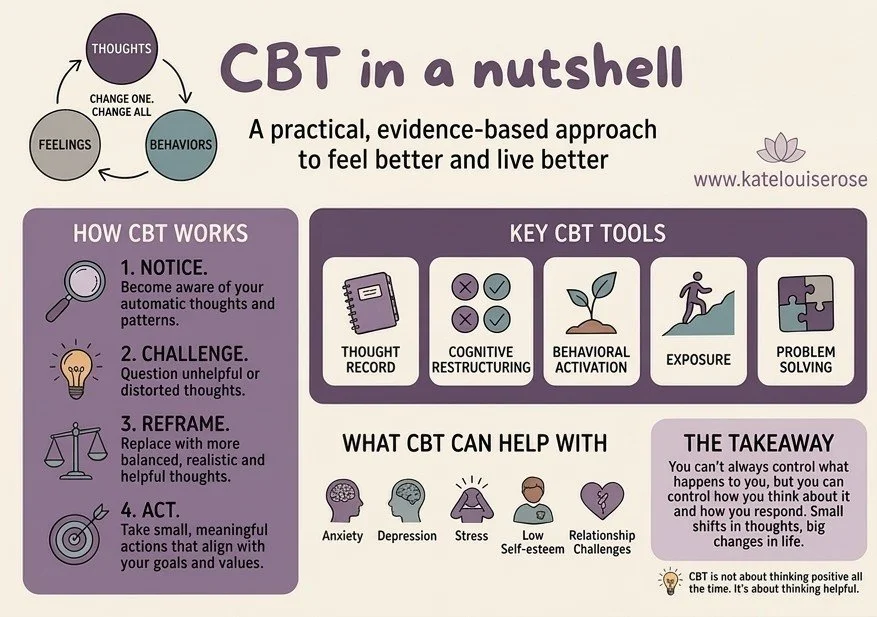
Cognitive Behavioural Therapy, or CBT, is a practical, evidence-based approach to help you feel better and live better. It focuses on the simple idea that your thoughts, feelings, and behaviours are all connected.
The CBT Model
What you think affects how you feel and act. What you feel impacts how you think. What you do changes how you feel and think. Because these three areas link together, changing one part changes the whole cycle.
How CBT Works
Notice: Become aware of your automatic thoughts and patterns.
Challenge: Question unhelpful or distorted thoughts. Ask yourself if a thought is entirely true, or if there is another way to look at it.
Reframe: Replace negative thoughts with more balanced, realistic, and helpful ones.
Act: Take small, meaningful actions that align with your goals and values.
Key Tools
Thought Record: Write down your thoughts to understand them better.
Cognitive Restructuring: Catch unhelpful thoughts, challenge them, and change them.
Behavioural Activation: Do more of what matters to you so you feel better.
Exposure: Face your fears gradually to build confidence.
Problem Solving: Break big problems down and solve them one step at a time.
What CBT Helps With
CBT supports people dealing with anxiety, depression, stress, low self-esteem, and relationship challenges.
CBT is not about thinking positively all the time. It is about thinking helpfully. You cannot always control what happens to you, but you can control how you think about it and how you respond. Small shifts in your thoughts lead to big changes in your life.
